



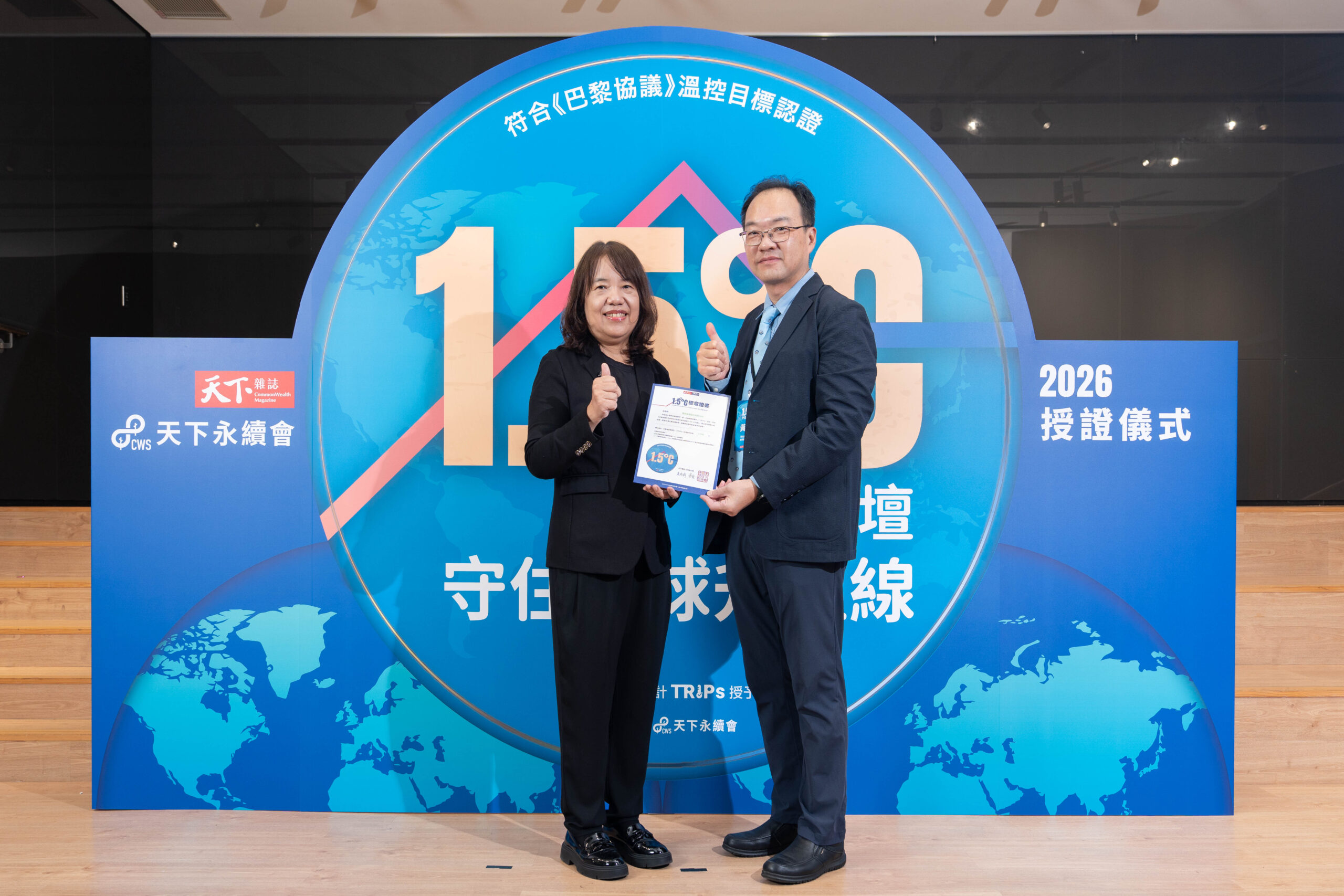
GlobalWafers continues to integrate climate action into its corporate operations and long-term development strategy. Through expanded renewable energy adoption, enhanced energy efficiency, process optimization, and carbon reduction management across its global operations, the Company is steadily advancing its low-carbon transition, with its achievements also recognized by external assessments. In June 2026, CommonWealth Magazine held the “1.5°C Corporate Carbon Reduction Forum and Certification Ceremony,” where it announced the latest results of its Temperature Rising Index for Pathways (TRIPs) and recognized companies whose decarbonization pathways align with the temperature goals of the Paris Agreement. GlobalWafers was rated “Below 1.6°C” and “Outstanding Performance,” with an assessment result of 1.542°C, demonstrating the Company’s continued efforts in climate governance and carbon reduction.
The Temperature Rising Index for Pathways (TRIPs), jointly established by CommonWealth Magazine and Tunghai University, is a public assessment platform that evaluates Taiwanese companies’ carbon reduction progress and temperature-rise pathways. Through science-based tools, the platform helps companies evaluate the alignment between their decarbonization commitments and implementation progress. Its assessment methodology categorizes companies based on their carbon reduction targets and current performance, compares their decarbonization pathways with international climate science models, and estimates the projected global temperature increase associated with each company’s emissions pathways through the end of this century. This year’s forum brought together representatives from more than 80 companies across the technology, manufacturing, financial, and service sectors to discuss how enterprises can use science-based management to track carbon reduction progress, strengthen climate governance capabilities, and move toward net-zero emissions.
With net-zero emissions by 2050 as its long-term direction, GlobalWafers continues to strengthen climate governance and carbon reduction management, while aligning its decarbonization targets with international climate standards. In 2026, the Company’s greenhouse gas reduction targets were validated by the Science Based Targets initiative (SBTi), marking concrete progress in GlobalWafers’ science-based approach to carbon reduction management. In terms of energy transition, GlobalWafers has also brought forward its Group-wide target for 100% renewable energy use from 2050 to 2040, and has set interim milestones of 35% by 2030, 55% by 2035, and 100% by 2040.
To increase the share of renewable energy use, GlobalWafers’ global sites are gradually advancing energy transition based on local energy conditions through self-built solar power plants, power purchase agreements, and the purchase of renewable energy certificates. Among these efforts, Danish subsidiary Topsil has commissioned its self-built solar power plant and become the Group’s first semiconductor crystal growth facility powered entirely by self-generated renewable electricity, serving as an important demonstration site for the Group’s green manufacturing and renewable energy transition. Looking ahead, GlobalWafers will continue to anchor its efforts in “Responsible Growth,” deepen climate governance, improve energy efficiency, and work with customers, suppliers, and stakeholders to foster a more resilient and competitive sustainable semiconductor value chain.