


GlobalWafers actively responds to the challenges posed by global climate issues and demonstrates its determination for a low-carbon transition by embedding “energy efficiency” and “green manufacturing” into the core of its corporate decision-making and future operational guidelines. We commit to leveraging systematic management frameworks to continuously improve our energy efficiency, thereby reducing the carbon emissions generated by manufacturing processes and business activities within our organizational boundaries.
All operating facilities under GlobalWafers (except for operation sites that have been in formal production for less than one year) have successfully implemented and maintained the energy management system (ISO 50001). By executing the PDCA (Plan-Do-Check-Act) continuous improvement cycle, we have deeply ingrained baseline comparison and the spirit of energy saving into our daily operations.
To advance green manufacturing, we focus on three key strategies: manufacturing process redesign, replacement of legacy equipment, and smart monitoring, supported by proactive operational management practices.
Through the collective efforts of our colleagues of global operation sites, GlobalWafers has demonstrated significant and steady electricity-saving performance over the past four years (2022 to 2025). The actual performance for each year are detailed below:
Over the past four years, GlobalWafers has consistently achieved significant annual electricity savings, resulting in a cumulative reduction of 48,321 MWh in electricity consumption. This reflects our strong commitment to turning low-carbon transition goals into tangible actions.
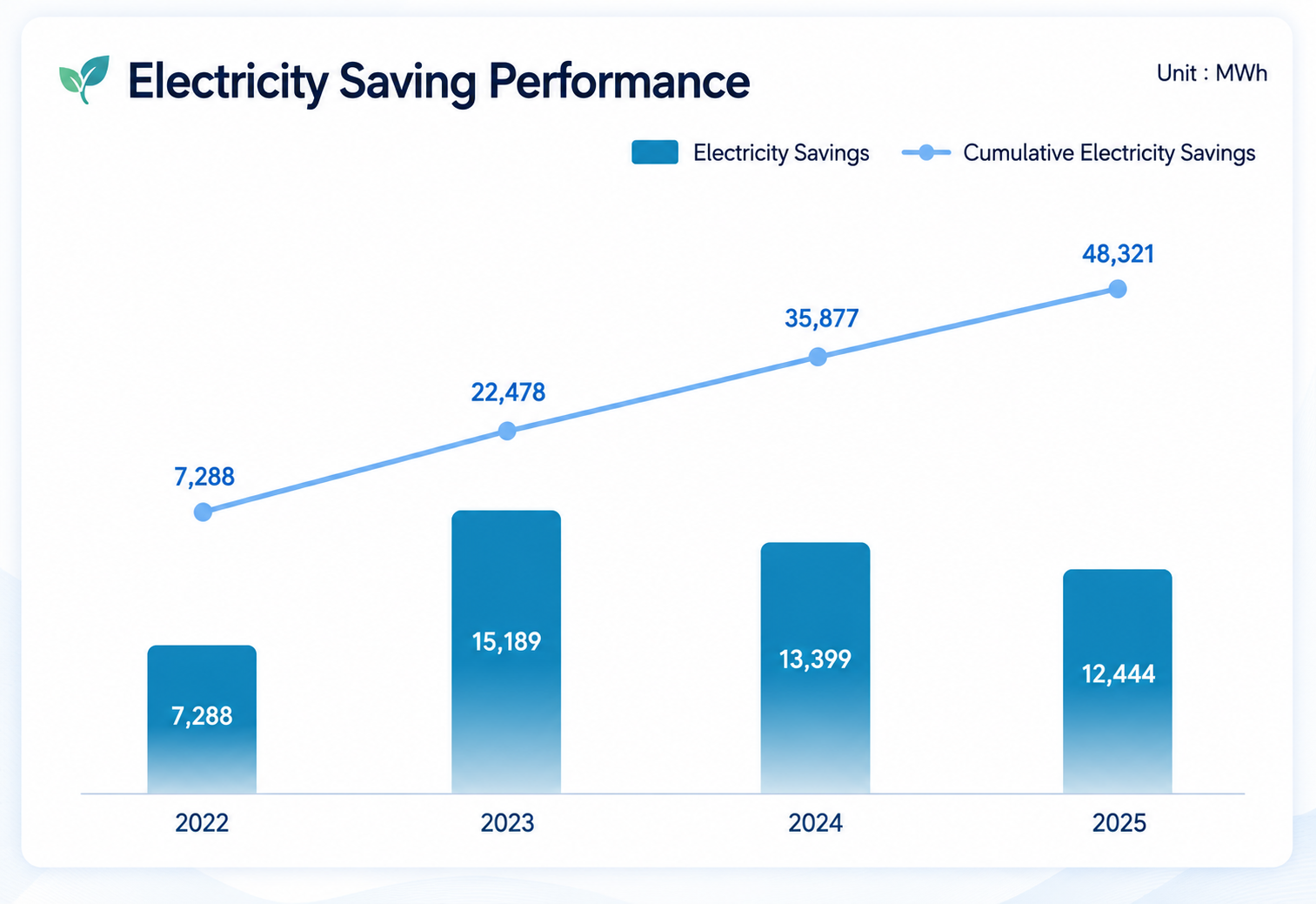
Achieving cumulative electricity savings of 48,321 MWh marks a significant milestone in GlobalWafers’ commitment to green manufacturing and its transition toward low-carbon operations. However, our efforts in energy optimization will not stop here.
In the years ahead, in addition to further reducing energy consumption and improving energy efficiency, GlobalWafers will continue to increase the share of renewable energy across its global operations in alignment with its RE100 commitment pathway.
To achieve this goal, we will adopt a diversified renewable energy strategy, including the installation of on-site solar photovoltaic (PV) systems, both rooftop and ground-mounted, within our facilities; securing stable renewable energy supplies through long-term Power Purchase Agreements (PPAs); and procuring Renewable Energy Certificates (RECs).
Furthermore, through cleaner production practices, green building standards, and the adoption of advanced low-carbon technologies, GlobalWafers will continue to advance its sustainability journey with a transparent, science-based, and systematic approach. Together with partners across the global semiconductor value chain, we are committed to achieving our long-term environmental sustainability goal of net-zero emissions by 2050.
To prevent fraud from impersonating the staff of GlobalWafers Co., Ltd. (“GWC”), of any financial institutions, or other identities in order to commit fraud, GWC hereby reminds you that our staff will never ask you to use an ATM, remit money, provide personal information, and/or make calls to / call back any suspicious number. GWC’s staff will not ask financial institutions to give you the above instructions on our behalf.
Because the caller ID can be faked, if you receive any call that the caller ID is GWC or its number starts with “+”, “+03” or “+886”, or the caller’s statement, instruction or accent is weird, please hang it up and directly contact our staff(Human Resources Department / Mr. Chen 03-5791213), and we also encourage you to call 165 anti-fraud hotline in order to protect your lawful rights.