



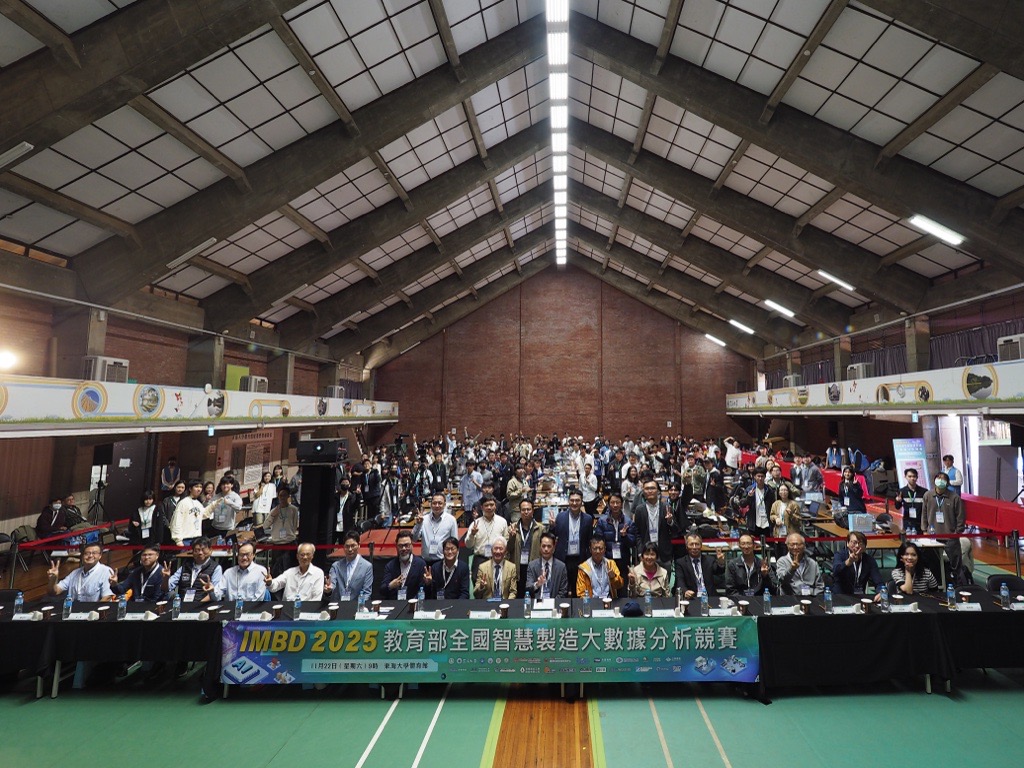
(Photo Source: Ministry of Education)
In today’s semiconductor manufacturing environment where efficiency and quality are paramount, data science and AI have become essential drivers of industrial advancement and sustainability. To bridge the gap between academia and industry, strengthen talent development, and accelerate the adoption of smart manufacturing, GlobalWafers participated in the Ministry of Education–guided “2025 Intelligent Manufacturing and Big Data Analytics Contest” as both a sponsoring enterprise and a problem-setting partner. The company provided real crystal-growth process images from actual production lines as training datasets, helping academic teams better understand manufacturing challenges and explore diverse possibilities of AI-driven intelligent detection.
As the sponsoring enterprise and problem-setting partner, GlobalWafers not only offered authentic process image data but also invested resources to support the competition’s organization and promote deeper industry-academia collaboration. This year’s event attracted 182 teams from 39 universities and 40 companies across Taiwan, making it one of the most representative activities in the smart manufacturing field. The challenge provided by GlobalWafers, “Automatic Detection of Crystal Growth Wire Breakage,” was entirely based on real manufacturing scenarios. It allowed participants to directly confront the dynamic characteristics of semiconductor processes, image-recognition requirements, and quality-control challenges. This valuable and highly specialized dataset enabled academic teams to apply AI, computer vision, and data-analysis technologies in an environment closely aligned with actual production, further strengthening Taiwan’s practical talent capabilities in smart manufacturing.
This collaboration not only fostered technical exchange but also contributed positively to several United Nations Sustainable Development Goals (SDGs):
 |
SDG 4 Quality Education |
GlobalWafers provided semiconductor process images that are typically difficult to access, enabling students and researchers to learn STEM knowledge through real-world cases that integrate theory with hands-on practice while cultivating interdisciplinary technical skills. |
 |
SDG 8 Decent Work and Economic Growth |
The competition strengthened participants’ capabilities in AI, data analytics, and process understanding, enhancing their career competitiveness. At the same time, it supported the industry in developing talent equipped to meet emerging technological needs, forming a virtuous cycle between learning and employment. |
 |
SDG 9 Industry, Innovation and Infrastructure |
The competition brought together innovative perspectives from academia and generated diverse model-development approaches. Participants proposed various feasible solutions for breakage detection and image recognition, offering more technical options for future process monitoring and building a solid foundation for ongoing industry-academia-research collaboration. |
 |
SDG 12 Responsible Consumption and Production |
If the related models are successfully implemented in production in the future, they could help reduce material waste caused by process abnormalities, lower energy consumption, improve process stability, and mitigate quality risks stemming from subjective human judgment, leading to a more efficient, energy-saving, and reliable manufacturing process. |
GlobalWafers remains committed to nurturing future scientific talent. Through this competition, the company leveraged its semiconductor expertise and resources to deepen social engagement—advancing smart manufacturing education, cultivating a new generation of AI- and data-capable talent, strengthening industry–academia collaboration and technological innovation, and driving sustainable manufacturing through digitalization, production optimization, and information transparency. These efforts further expand GlobalWafers’ positive impact on society. Moving forward, GlobalWafers will continue expanding its collaborative efforts to support talent development, research advancement, and industrial innovation on the path toward sustainable and intelligent manufacturing.